The Foundational
Years.
Nursery to Class II · Ages 3–7 · Wing Lead: To be updated
Where a love of learning is formed — or quietly extinguished.
We protect the slowness of early childhood.
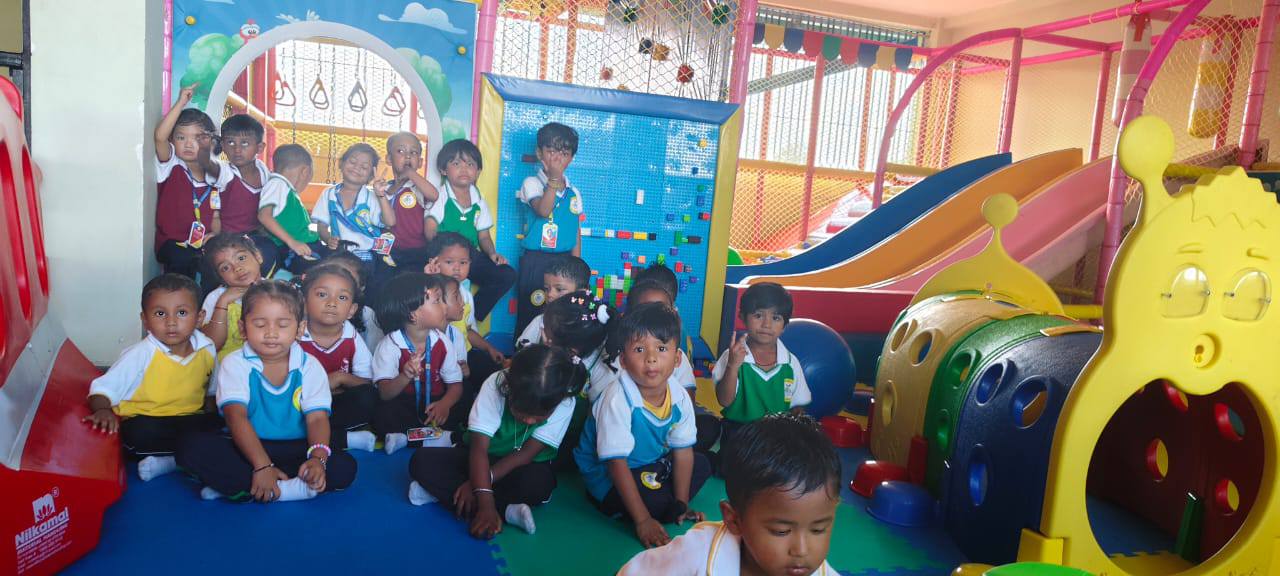
Young children learn by doing and by being read to — not by sitting still in front of a worksheet. Mornings begin with a circle, a story, a song, and thirty minutes of outdoor time before any desk work begins.
Phonemic awareness is built through Jolly Phonics, supported by an English-rich classroom. Number sense begins with concrete materials — beads, blocks, the seasonal calendar — long before any formal numeral work. The hand understands before the symbol.
We send children home tired in the legs and the imagination, not the hands. No child is made to feel behind. No child is made to feel done. The pace of reading readiness is respected for each child individually — a child who is pressed before they are ready learns to hate reading, which is the one outcome we are most careful to avoid.
By the end of Class II, a child should: read independently for pleasure; write a clear paragraph about a personal experience; count to a hundred with full understanding of place value; and be able to lose a game without losing composure.
Progress is reported as a written narrative twice a year — November and March — shared with parents in a face-to-face meeting. No marks, no ranks, no percentages. The narrative describes what the child can do, what they are working on, and what parents can do at home.
Every child in Nursery–Class II brings a tiffin from home. During snack time, children share with the group — building conversation, generosity, and the social vocabulary of food. Canteen access begins from Class III.
Subjects & learning areas.
Each child selects their own book. Reading logs are maintained from Class I. Parents receive a termly reading report alongside the written narrative. Children who do not yet read independently are read to by the teacher — aloud, slowly, repeatedly, without embarrassment.
Monday, Nursery.
| Time | Activity | How & Why |
|---|---|---|
| 8:30 AM | Arrival · Morning Circle | Welcome song, date board, weather chart, show & tell — builds oral language and belonging |
| 8:50 AM | Phonics / Reading | Jolly Phonics group work · letter of the week · decodable reader in pairs |
| 9:30 AM | Outdoor Block | Free play with structured apparatus · gross motor development · 30 minutes minimum |
| 10:00 AM | Snack · Share & Care Tiffin | Tiffin sharing · social conversation practice · turn-taking |
| 10:20 AM | Mathematics | Counting with beads · sorting objects · pattern building — manipulative first |
| 11:00 AM | Story Time / EVS | Read-aloud by teacher · discussion · connection to EVS theme of the week |
| 11:40 AM | Art / Music / Movement | (Art & Music), (Dance) · integrated with weekly theme |
| 12:15 PM | Lunch | Supervised · tiffin · hand-washing routine taught and observed |
| 12:45 PM | Hindi / Library | Oral Hindi rhymes and songs / free-choice library reading |
| 1:00 PM | Dispersal | Bus and parent pickup · supervised exit · student released only to registered guardian |
HOMEWORK: None in Nursery–UKG. Class I–II: max 15–20 minutes of reading only. No written homework sent home.
Joining the Foundational Wing.
One-time admission fee (fresh students only): ₹ 3,000 · Existing students: no admission fee. Source: FRC Order 17-12-2026-FRC-F-273249 · 19 Dec 2026.
There is no written entrance test for Nursery or LKG. We invite the child and a parent for a 20-minute informal classroom visit. The child plays; we observe engagement, curiosity, and disposition. No coaching is required or useful. No right or wrong answers exist.
For Class I upwards: a brief, informal reading and number-sense interaction — not a test, but a conversation — helps us understand where the child is so we can support them from day one.